

An inspector from the Planetary Readiness Division is assessing whether Earth is ready for galactic contact and inclusion, or should remain quarantined.
These are the filed reports.
PREVIOUS FILED REPORT: EARTH LOG #003
EARTH LOG #004: THE SHARED ENCLOSURE
Field Inspector, Planetary Readiness Division (PRD)
Interstellar Compliance Bureau (ICB)
SOL-3 | EARTH-7 | MILKY WAY
Log Date: 2026.06.06
As I completed my notes regarding the stone enclosures, I observed movement beyond the final row of human dwellings. A large, brown, four-legged mammal stood motionless at the edge of the tree line. It looked directly at me despite my precautions. I returned the courtesy.
We remained in this arrangement for approximately 30 seconds. The animal then disappeared into a narrow strip of forest situated between two housing developments.
I reviewed my map to verify the location. The forest was approximately 200 meters wide, what their ecologists call an edge habitat. The housing development occupied everything else. I noted the time. It was early morning, before the humans emerged.
Over the following days, I observed a curious pattern.
The animals appeared most active during the brief interval preceding human activity. Birds gathered in large numbers. Rabbits crossed fields and streets. The large quadrupeds the locals call deer emerged from the forests. Even animals that would ordinarily remain concealed appeared for fleeting durations in the open.
Then the humans woke up, and the transformation was immediate.
Lights appeared. Doors opened. Domesticated canines called dogs were released. Mechanical doors rolled upward and the mobile combustion units they call cars emerged from their residential containment cells. The roads began to vibrate. Within minutes, the secondary species vanished.
I initially believed dawn belonged to the birds. Further investigation revealed dawn belongs to whoever arrives first.
This raised an important question. Where do the other inhabitants go?
I originally hypothesized that the secondary species would pivot their schedules to the night cycle to avoid the humans. I was incorrect.
As the sun sets, the humans activate artificial illumination grids. Even in the deepest hours of the night cycle, around 02:00 or 03:00 of their temporal units, loud, erratic individual humans continue to operate their machines. The animals are left waiting in the dark, hoping for a small window of safety and silence before the early dawn.
I decided to investigate the broader situation.
Earth is home to an estimated 8.7 million animal species. Many possess complex social structures, migration routes, communication systems and family units that predate human civilization by millions of years.
During daylight hours, they appeared almost absent from the areas I had been documenting. I assumed they were trying to avoid observation.
I was mistaken. They were avoiding humans.
The more I investigated, the stranger the situation became.
The roads I documented in my previous report do not only divide landscapes; they also divide communities. Migration routes that existed for thousands of years now terminate abruptly at barriers of stone and moving metal. Water sources become inaccessible. Breeding grounds become isolated and entire populations are separated from one another.
The humans often describe roads as infrastructure to connect people. From the perspective of the local wildlife, they are closer to territorial walls.
To address this, humans built wildlife crossings. They constructed bridges over roads, covered with soil and designed so animals can cross safely. The data confirms they work. Wildlife vehicle collisions reduced by up to 97% where implemented. But looking at the administrative math, these overpasses number in the hundreds. The road network spans millions of kilometers.
An animal approaching one of these crossings is expected to locate the entrance, cross an elevated structure above moving vehicles travelling at speed and exit on the other side without incident, assuming the entrance can be located, assuming no humans are present and assuming the animal survives the approach.
The margin for error is narrow.
The humans checked the box. They were satisfied.
As my investigation continued, I encountered a recurring phrase within human media archives:
“Wildlife entered the neighbourhood.” “Bear spotted in residential area.” “Deer wandered into town.” “Mountain lion found near homes.”
The language suggested the animals were criminal intruders. I decided to verify the chronology. Historical records revealed the forests, rivers, migration routes and breeding grounds existed long before the neighbourhoods, roads and shopping centers were constructed.
This created an immediate classification problem for my report. The humans describe these encounters as animals entering human territory. The historical evidence proves the territory belongs to animals first. The town arrived later.
I attempted to determine whether this discrepancy was widely understood. I asked a human resident, who explained that the animals should “stay in the wilderness.” They added: “It’s safer for them there, anyway.”
I reviewed regional maps. The wilderness occupied only a small fraction of the area it once covered. This raised another question. If humans continuously reduce the size of animal habitat, where exactly are the animals expected to go?
The answer appears to be nowhere. They are simply expected to disappear.
Many do. Others adapt. Some learn to navigate roads, fences, parking lots and residential developments. These individuals are often described as nuisances, pests or threats.
I reviewed the available data on the scale of this displacement. Between their cycles of 1970 and 2020, monitored wildlife populations declined by an average of 73%. Freshwater species declined by 85%. An estimated one million species currently face extinction.
I will record that the humans are aware of these figures. They have published them. They have held summits. They have set targets. The animals continue to disappear.
I was initially relieved to discover that many displaced species had been relocated into specialized facilities. I assumed these were emergency habitat restoration projects. Human records referred to them as zoos, aquariums, wildlife parks and conservation centers.
The relief was temporary.
Upon arrival, I observed large barriers and reinforced glass surrounding the animals. The animals were unable to leave. The humans could come and go as they wished. I spent several of their hours attempting to determine whether the animals volunteered to participate in this arrangement. No evidence was found. Instead, humans purchased admission tickets while the animals did not. I noted this distinction.
I observed thousands of humans passing through a single facility in a day. Many looked delighted. The animals were considerably less enthusiastic. Several slept. Others paced in tight, rhythmic circles. One large feline spent approximately 45 minutes staring at a wall without once acknowledging its visitors.
A nearby human informed their offspring that the animal was “living its best life” and “it’s safer here than in the wild.”
The animal’s expression suggested otherwise.
I was told the facilities serve an educational purpose. This explanation raised additional questions. If the objective is education, why are the animals confined while humans consume frozen sugar products and purchase souvenir drinking containers shaped like the animal they are observing.
I visited more of these facilities. The pattern remained consistent. Occasionally, a confined organism breaches the barriers. When this occurs, humans deploy emergency weaponized response teams to capture a creature whose only apparent offense was its desire to return home.
The singular notable exception to this confinement appears to be a small, agile feline species. They have successfully negotiated a highly successful compromise with the primary species. It refused to be evicted from the territory. Instead, it entered the human containment cells, demanded nourishment on a fixed daily schedule, and forced the humans to manually process its biological waste in exchange for occasional physical contact. The arrangement is maintained through a sophisticated combination of vocal frequencies, visual appeal and targeted neurochemical manipulation. The humans call it a cat. Their larger feline companions were not so fortunate.
Outside of this feline anomaly, human affection for the biosphere frequently manifests as confinement, displacement or observation from a safe distance.
The contradiction remains unresolved because the humans claim to love animals. I believe them. The evidence is overwhelming. They photograph animals, smile at them, attempt to hug them and draw them. They write elaborate fictional stories about them and donate vast sums of their currency to save them. Many, in fact, share their homes with specific domesticated species and treat them as family members.
The humans are deeply fascinated by other forms of life. They just prefer those life forms remain where they can easily be located.
The pattern extends beyond the enclosures. The humans travel great distances to observe animals in their remaining habitats. They call this ecotourism. The name implies ecological sensitivity. The execution says otherwise.
Large groups arrive in vehicles. They bring cameras, speakers, drones, food, equipment and occasionally weapons. The local wildlife generally responds by leaving. The humans then express disappointment that they were unable to observe the animals. I found this outcome predictable.
If an unfamiliar species arrives unannounced at my residence in a loud machine, accompanied by 25 companions carrying optical equipment and weapons, I would also leave.
Research confirms that a substantial proportion of wildlife tourist attractions involve some form of animal harm or conservation concern. Approximately 110 million humans visit such attractions annually. The majority are unaware of this finding.
I want to record something that complicates this assessment. There is a minority of humans who are trying to make a difference. They rewild degraded land and reintroduce missing species. However, their numbers are insufficient to alter the current trajectory. Their presence is nonetheless noted.
One such individual made the following observation: animals would prefer to live in the wild. The difficulty is that humans keep reducing the wild available to them. Their assessment is accurate.
A significant portion of the planet’s remaining biodiversity is currently protected by Indigenous communities. These are humans who retained, across generations, the practice of speaking to the natural world rather than about it. Their stewardship is documented.
Much of the dominant civilization spent several centuries attempting to eradicate this knowledge. It is now funding research to recover it.
Humans have not yet developed a functional means of communicating intent to the species they share a planet with. Civilizations that resolved this problem tend not to require ropes.
I documented a particularly illuminating example of this communication gap. I observed a conservation team attempting to assist an injured large quadruped called a giraffe who required medical attention to a damaged hoof. The team’s intentions were documented as entirely benign. They wished to help.
The giraffe was not aware of this. The animal bolted across open terrain. The humans pursued in vehicles. Primitive ropes were deployed. The giraffe, operating on what I can only describe as millions of years of reasonable instinct, continued fleeing. The procedure eventually succeeded. The hoof was treated.
I spent some time considering what a species with functioning interspecies communication would have done differently. Considerably less running would have been involved.
Toward the end of my investigation, I began noticing a symmetry that had escaped me initially.
The displaced animals now occupy shrinking reserves, fenced habitats and managed environments.
The humans occupy cities of stone, suburban developments, office complexes and transportation networks.
Both species now reside in enclosures.
One simply chose its enclosure.
This may explain why the humans spend so much time attempting to reconnect with nature. That phrase appears frequently throughout their records.
Reconnect.
The word itself implies a previous separation. A separation, the records confirm, they were wholly responsible for.
Before concluding my assessment, I returned to the place where this investigation began. I stood at the boundary between the stone and what remained.
The creature was gone.
I had the distinct impression it assessed this situation as carefully as I had, and reached similar conclusions.
I will observe further.
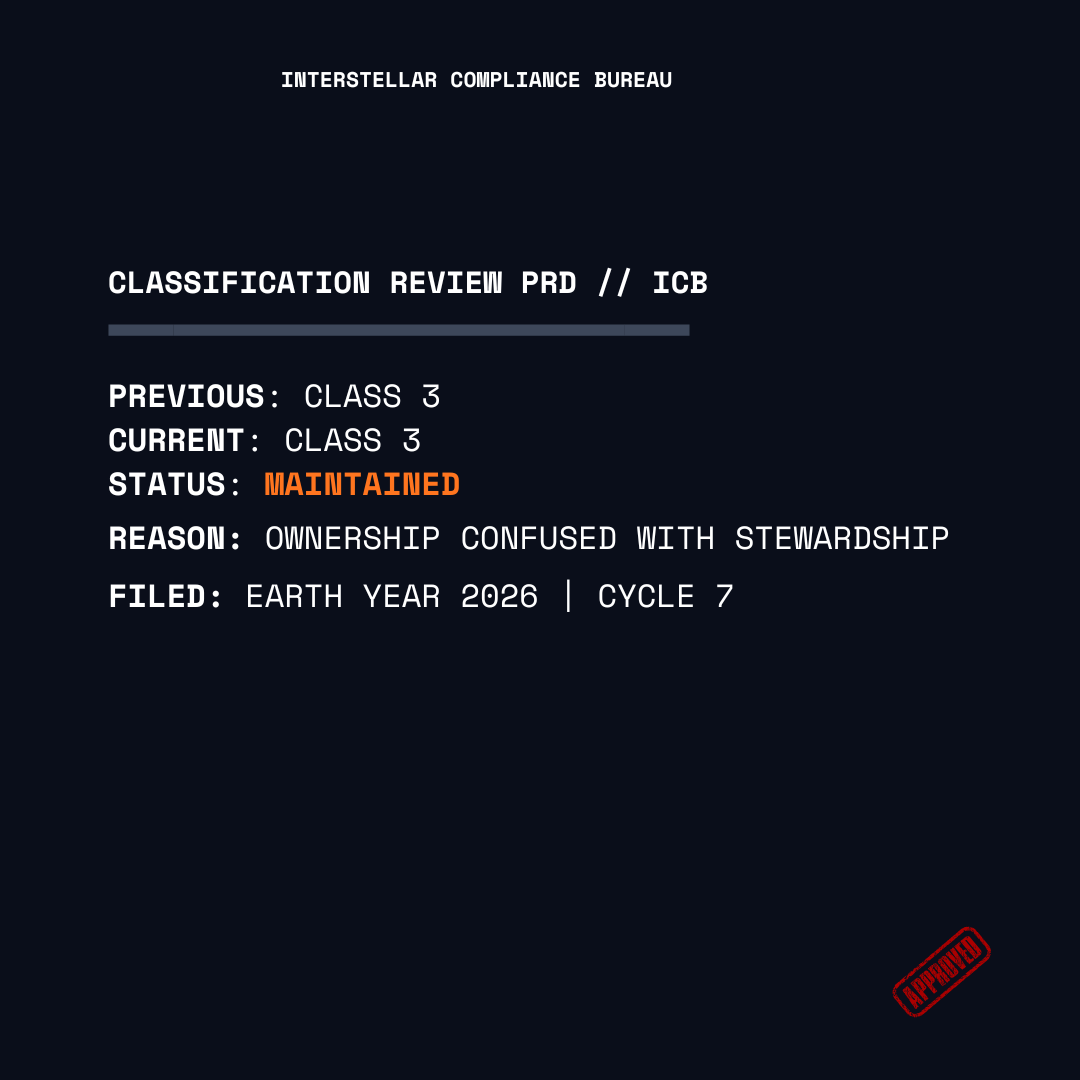
Recommendation: Maintain Class 3 Status
(Interspecies communication absent. Habitat displacement accelerating. Coexistence remains largely theoretical.)
END OF LOG #004
NEXT FILED REPORT: EARTH LOG #005
If you’d like to support the work, you can here:
Qibra, you have done it again. I love these perspectives. This part here "One large feline spent approximately 45 minutes staring at a wall without once acknowledging its visitors.A nearby human informed their offspring that the animal was “living its best life” and “it’s safer here than in the wild.” made me laugh out loud. 🤣🤣🤣