

An inspector from the Planetary Readiness Division is assessing whether Earth is ready for galactic contact and inclusion, or should remain quarantined.
These are the filed reports.
PREVIOUS FILED REPORT: EARTH LOG #004
EARTH LOG #005: THE PHOTON SIEGE
Field Inspector, Planetary Readiness Division (PRD)
Interstellar Compliance Bureau (ICB)
SOL-3 | EARTH-7 | MILKY WAY
Log Date: 2026.06.14
I had been looking down and documenting the chaotic activities on the planet’s surface for so long that I had neglected to record what was happening above.
The first time I looked up, I could not find the stars. They were gone.
Let me clarify. They are not gone in any cosmic sense. I have confirmed their physical existence through standard navigational instruments. They are simply no longer visible from the surface of this planet because the humans have declared an unconditional war on the night.
I will need a moment to process the illogic of this.
…
The first time I noticed this, my chronometer indicated the local region rotated into sunset. By all laws of planetary physics, it should have darkened. I adjusted my optical receptors to compensate for the anticipated darkness, but that was unnecessary.
The sky above the human settlement was not black. It glowed a harsh amber. The stars were entirely absent, and for a brief alarming moment, I suspected an atmospheric chemical ignition event. I quickly realized the truth was far more shocking. It appears the humans have filled the night with their own light.
I decided to investigate when this began.
For most of their history, humans navigated, farmed, celebrated and made sense of their existence by the light of stars. Their earliest calendars were written in the sky. Their oldest stories lived there. Every civilization on this planet, without exception, oriented itself by the night sky.
Then came what they call the Industrial Revolution.
According to their historical archives, this photon siege began during that period. Their factory administrators discovered that by hanging primitive burning filaments over their assembly lines, they could override their laborers’ biological sleep signals in order to manufacture goods indefinitely. It was, at its origin, a corporate optimization strategy, and one the population willingly accepted. Streets needed illuminating so commerce could continue after sunset, Gas lamps appeared in the late 1700s, and electric street lighting followed in the late 1800s.
Over the centuries, they forgot it was supposed to be a temporary measure. They converted it into a permanent planetary setting.
Worse, they engineered their outdoor illumination devices to face sideways and upward. From orbit, their cities flare like neon distress signals burning through their limited fossil fuel reserves to light up the space above them.
They have recently discovered a concept where they can point the light downward, toward the ground where they actually walk. They are calling this modern engineering. The transition, however, is chaotic. Half the planet is installing shielded luminaires, while the other half is still operating large illuminated rectangles that broadcast the price of vehicles directly into the cosmos at 03:00 AM. They have wrapped their entire civilization in a dense shroud of wasted photons. My scans confirm that billions of lumens are generated every second by vast, archaic electrical grids.
This brings me to the core theme of human resource management that I have now documented multiple times.
First, nature provides a vital mechanism for free, at no cost.
Next, the humans aggressively disrupt or destroy it.
Then, they replace it with an expensive artificial substitute.
Finally, they spend immense resources attempting to survive the consequences of the substitute.
Allow me to demonstrate.
Let’s take their biology for instance. Like all organisms evolved on this world, the humans possess a circadian rhythm. This is an internal clock governed by a molecule they call melatonin. This molecule acts as an important cellular defense system which protects their bodies against genetic mutation and neurological decay. The complication is that it can be produced most effectively in absolute, uninterrupted darkness.
By flooding their nights with artificial light, the humans have initiated a form of slow, collective chemical revolt against their own bodies. They suffer from chronic sleep deprivation, systemic anxiety and a growing catalogue of health complications associated with circadian disruption. To manage the consequences of the light they themselves created, they spend billions of units of currency on chemical sleep aids, weighted blankets and opaque window covers.
That is correct. They buy darkness back from the market, and they seem quite satisfied with this arrangement.
I continue to find it difficult to justify.
The madness is not confined to their city streets. I conducted an evening observation inside a human dwelling. It turns out, even when humans retreat inside their small, residential boxes, they activate manual switches that flood their living quarters with a blinding light that my scanners confirm mimics the radiation signature of a midday tropical sun. They sit directly under this artificial noon while consuming late-night sugary substances, and then express profound confusion as to why their bodies resist sleep.
They have successfully engineered a way to maintain a perpetual state of temporal whiplash by tricking their own eyes into believing they are stranded on the equator at noon, every night, indefinitely.
I witnessed a domestic dispute regarding this exact phenomenon between two humans. The female human, exhibiting signs of advanced exhaustion, attempted to engage the male human in a logical course correction.
“Can you please turn off the overhead lights? It’s too bright and it’s almost midnight. Just turn on the lamp or light a candle. My head hurts.”
The male, staring blankly at a glowing rectangle, replied, “If I turn off the main lights, it’s too dark. I can’t see what I’m doing.”
“YOU AREN’T DOING ANYTHING!” She observed correctly. “YOU’RE JUST SITTING ON THE COUCH WATCHING A STUPID FOOTBALL MATCH.”
“Yeah, but I like the lights on,” he insisted. “Just go to the bedroom if it bothers you so much,” he continued, defending the simulated midday sun with remarkable loyalty. The exchange ended in a stalemate. The solar forgery remained active.
This is not all.
The humans possess various sizes of glowing rectangles, all of which emit melatonin-disrupting blue frequency light. Curiously, they have categorized these rectangles by safety. They believe the large stationary rectangle, which is called the television, is safe for bedtime preparation because it is positioned at a distance and puts them into a vegetative, hypnotic state. However, they immediately follow this by placing another small, handheld rectangle called a smartphone approximately two inches from their eyes right before closing them. I am not quite sure where the smart in the smartphone comes from. If the device were functioning as its name implies, if it were indeed smart, it would—at a minimum—instruct its user to turn it off or better not emit that blue light at all. It does neither.
When humans cannot sleep, they do not blame the light-emitting rectangles they stared at for hours. They do not identify the various photons they blast into the atmosphere at night. Instead, their medical industry blames a mysterious disorder called insomnia and manufactures billions of synthetic chemical compressed powders to force their brains to shut down.
Yes, that is right. They are paying money to buy darkness in a pill because they destroyed the darkness available freely outside their windows.
I observed this fascinating loop of self-inflicted chaos myself. At approximately 22:00, the male human finally deactivated the bright overhead suns, the two larger rectangles (the television and the laptop) and laid in his resting chamber. I noted, with cautious optimism, this particular human did not have a glowing night light in his chambers like the others. This appeared to be progress.
He then activated the smartphone.
The device emitted short wavelength blue light at close range into his eyes for approximately 2 hours. His biochemistry was convinced it was midday while his physical anatomy was collapsing from exhaustion. He was voluntarily torturing his own nervous system with the small glowing screen.
At 00:17, the human placed the rectangle on a surface beside his sleeping area. The rectangle did not stop releasing light. I observed as notifications, useless data transmissions from other awake humans, arrived causing the screen to flash periodically throughout the night.
Even when the screen went dark, the assault continued. Outside the dwelling, light from street lamps and neighboring houses continued to leak directly through the porous window blinds accompanied by the chaotic flashes and sounds of passing vehicles.
The human slept, but their body remained in low-level alert the entire night as their brain continued to register the flashes of light and noise. At 07:30, the human rose and reported feeling unrested.
I was not surprised. The human body requires extended periods of total planetary darkness and silence to repair their neural pathways. He had received none.
Upon further investigation, I discovered that the humans have developed a feature called Night Mode for their smartphones. Its purpose is to reduce the blue light emission after local sunset by shifting it to a warmer tint that is less disruptive. What I find interesting is that this vital biological protection feature is not activated by default. The human I had been observing never enabled it.
I searched for better solutions. They do exist. Warm spectrum lighting that preserves circadian rhythms has been developed and is commercially available. Several municipalities have begun switching their street lighting to warmer wavelengths. The humans possess the exact engineering required to fix this crisis. They have not implemented it at scale because the brighter, cheaper, cooler lights are more economical to run. They are disrupting the sleep, sanity and biological stability of their entire civilization to save money on electricity.
The ecological toll is severe. Artificial light at night acts as a biological weapon against the planetary biosphere.
Allow me to explain.
Migrating bird species navigate by using the placement of stars. They are now disoriented by the glowing cities and collide with towers by the millions. It is recorded in their archives that an estimated one billion birds collide with illuminated buildings annually in their region of North America alone.
Sea turtle hatchlings emerge at night and navigate toward the brightest horizon, historically that was the ocean. Now, they frequently move toward coastal developments instead. Many do not survive.
Nocturnal insect pollinators, the very creatures responsible for maintaining the human food supply, are drawn away from their flora. They are fatally attracted to artificial light sources. They fly in desperate, frantic circles around streetlamps until they drop from exhaustion.
The humans have named this phenomenon as a moth to a flame. They have known about it for centuries and recorded it in their literature. They chose to light the planet anyway.
I noted that this civilization removed complex, bioluminescent ecosystems such as forests, wetlands and coastal areas that once produced their own soft natural light. They replaced them with dead, toxic sodium-vapor and LED grids.
They traded living light for dead light and then forgot they had made that trade.
Perhaps the most tragic consequences of this photon siege is the psychological and cultural isolation. To be precise, 80% of the world’s population now lives under skies so altered by artificial light that the night, as it naturally exists, is no longer visible to them. In the regions they call Europe and North America, this figure rises to 99%.
I had to sit with that figure for a moment.
An entire generation of humans on this planet has grown up without ever seeing the actual universe they inhabit. They have read about the stars. They have seen them in films. Some even purchased decorative ceiling attachments that simulate them indoors, but they have not seen the actual stars above their own roofs.
The depth of this sensory deprivation is perfectly illustrated by an event that occurred in their chronological year of 1994. A tectonic disturbance or what they call an earthquake disrupted the electrical grid across a major settlement known as Los Angeles. In the hours that followed, local emergency services received a surge of concerned and panicked calls from residents reporting a strange phenomenon in the sky. They reported a vast, silver cloud that had appeared overhead.
That terrifying anomaly was the Milky Way.
It was their own galaxy.
It was visible for the first time in decades to millions of citizens who had never seen it and therefore did not know what it was.
I have filed this under a special index: Civilizational Information Gap. Severity–Critical.
Nowadays, when a human desires to observe the universe, they must engage in an activity called Dark Sky Tourism. They must spend currency, pack resources and travel thousands of kilometers to remote deserts or isolated mountain peaks just to catch a glimpse of the natural night sky.
They pay corporate entities to look at the sky they chose to erase from their own backyards.
The solution to this entire crisis is simple. It requires no advanced interstellar technology. They could install physical, downward-facing shields on their emitters, and use basic motion sensors so lights can only activate when a human is physically present. They could also effortlessly replace all existing bulbs with their dimmer, circadian-rhythm-friendly counterparts.
These solutions exist. They are commercially available. In fact, several municipalities have begun implementing them.
The obstacle is economic. When I proposed this to a local regional planning committee, they stared at me with blank confusion. They cited a deeply embedded cultural fear of the dark.
They would prefer long-term biological degradation over a dark sidewalk.
Another thing worth mentioning is how this civilization completely ignored their own biological potential. Their eyes possess a highly efficient chemical compound called rhodopsin which if allowed just 30 minutes of darkness, can amplify their visual sensitivity up to 10,000 times. Once dark adapted, a human is fully capable of navigating a moonlit landscape using only their natural vision.
Because they reset this chemical loop to zero every time they stare at a glowing screen or walk past a street lamp, they have convinced themselves that they are entirely blind in the dark. They choose to blind their own organs every evening, and then use that self-inflicted blindness to justify building even more street lamps.
This is reinforced by their ancestral cultural programming. From infancy, humans tell stories where darkness is equated with malice, danger and civilization collapse. Their children grow into young adults who believe that dark is bad and light is good. They have weaponized their own mythology to induce an irrational, species-wide phobia of their planet’s shadow.
I have also found that they measure the advancement of entire nations by the robustness and intensity of their electrical grids. On this world, darkness indicates backwardness while light indicates progress. They have turned the destruction of their night sky into a civilizational scoreboard. The more a nation can blast its territory with artificial noon, the more civilized it considers itself to be.
They told themselves the bright street lights were necessary for safety to stop crime. Now their modern criminologists have found that overly bright street lights can actually increase certain property offenses as the intense glare prevents passersby from adjusting to observe shadowed areas, making it easier for criminals to hide in plain sight. The lights installed for safety are, in specific circumstances, providing cover for the activity they were designed to deter.
On other worlds I have surveyed, the problem of nighttime navigation was resolved through a different approach. They adopted an ecological collaboration. Many civilizations cultivated and encouraged bioluminescent ecosystems rather than flooding darkness with artificial light. I have seen paths marked by glowing organisms, cities softened by living light that responded to movement and faded when no longer needed. Light on those worlds was treated as part of the ecosystem rather than an assault imposed upon it.
The humans are not unaware of this concept. They describe it as magical. They travel to see it in the few remaining places where it exists naturally including glowing bays, firefly meadows and deep ocean footage they watch on screens in their artificially lit rooms. They find it beautiful, but they have not chosen to build their world around it.
They possess the keys to permanently sever their dependence on the electrical grid and heal their atmosphere, but they refuse to abandon their current economic structure and surrender to the natural cycle of the planet.
In order for the solution to work, they would have to accept that when the planet rotates away from its star, the world gets dark, high-speed travel stops and the species go to sleep. This is not something they are willing to do at their current cycle of evolution of 2026.
They are truly a species absolutely terrified of pausing.
As a final act of desperation to keep their artificial network active, they have recently begun launching tens of thousands of reflective communication devices into low orbit. These satellites scatter and reflect sunlight across the sky, contaminating the darkness from above.
They have littered their own sky from outside which means that even if they managed to turn off their grids on the ground, their corporate satellites will continue to blink at them from the void, making deep sky observation impossible from the surface. They would rather drive their biosphere to the brink of collapse, blind their own eyes and pollute the orbit of their planet than face a few hours of quiet, natural darkness and rest.
The ultimate irony of the human species is that they view their war on the night sky as a triumph of freedom. They believe that by conquering darkness, they have freed themselves from the tyrannical clock of their solar system.
The reality is tragic. They did not conquer the night to achieve freedom. They conquered the night so they could work longer shifts. They destroyed the beautiful, peaceful shadow of their world to ensure their commercial factories and digital streams never have to pause.
Humans have voluntarily locked themselves into geometric stone enclosures to escape the intelligence of the planet. They have installed miniature suns and glowing screens in their enclosures and glowing grids over their cities, frightened of the very darkness that is designed to heal them.
Further observations will follow.
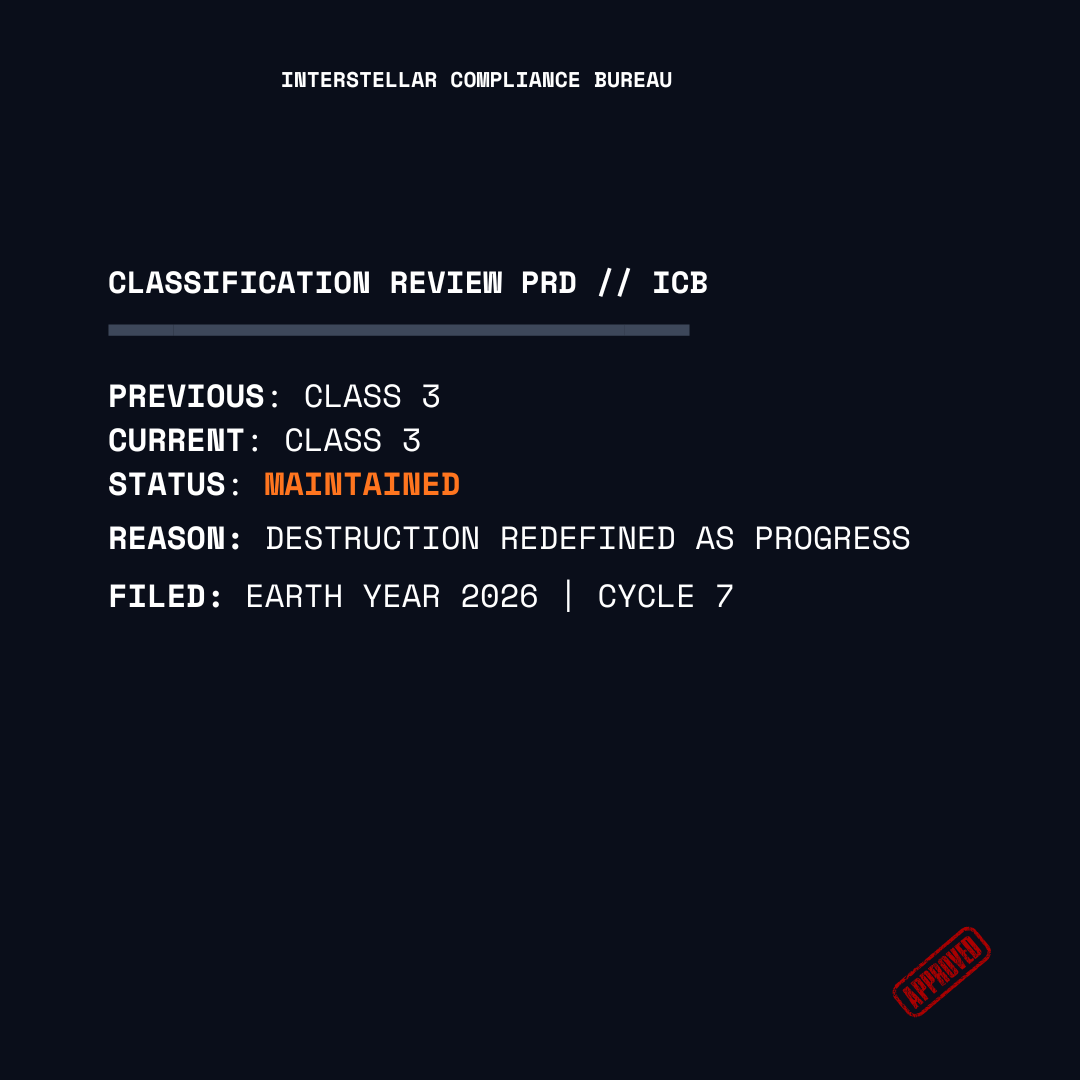
Recommendation: Maintain Class 3 Status
(Self-inflicted sensory deprivation confirmed. Chronic biological rhythm disruption widespread. Solution available. Implementation absent at scale. Civilization remains incapable of cooperating with basic planetary rotation cycles)
END OF LOG #005
If you’d like to support the work, you can here:
Once the inspector observes our war techniques I fully expect our score to be downgraded significantly.