

An inspector from the Planetary Readiness Division is assessing whether Earth is ready for galactic contact and inclusion, or should remain quarantined.
These are the filed reports.
PREVIOUS FILED REPORT: EARTH LOG #006
EARTH LOG #007: The Burial Ritual
Field Inspector, Planetary Readiness Division (PRD)
Interstellar Compliance Bureau (ICB)
SOL-3 | EARTH-7 | MILKY WAY
Log Date: 2026.07.21
[The log opens with a loud, piercing BEEP…BEEP…BEEP of a reversing garbage truck, followed by a louder mechanical BANG.]
…
(A long, heavy sigh)
My auditory membranes have not fully recovered from the deafening, incessant backup alarms of the human waste collection vessel. Nevertheless, I decided to follow the metal beast to its home.
During this investigation I repeatedly heard humans use the phrase, “Just throw it away”.
Curious, I requested the geographical coordinates of “Away.”
No human could provide them. I therefore followed the collection vessel myself.
What I witnessed over the next 72 hours required significant processing time before I could file this report with certainty.
I will describe my investigation in the order it unfolded.
The vessel traveled first to a facility the humans call a transfer station where the compacted contents of several hundred residential units were emptied into a larger holding structure. At first, this appeared encouraging. Workers and machines removed obvious recyclable materials, hazardous substances and oversized objects.
For approximately 5 minutes, I developed renewed optimism regarding this civilization. I assumed they were transporting materials to a central recovery facility before returning them to productive use.
I was mistaken.
After this preliminary sorting, what remained–which constituted the majority of the bulk–was loaded into larger transport vessels and driven to its final destination.
I followed them.
They led me to a place humans call a landfill. It is an enormous cavity excavated into the surface of the planet. Humans transport the objects they no longer wish to think about into this abyss. They then cover the objects with soil. Apparently, this creates the psychological impression that the problem no longer exists.
The following day they repeat the procedure. This continues until the cavity is full. It is then sealed and monitored for decades to ensure it does not poison the surrounding environment. Once sealed, humans excavate another cavity nearby.
At first glance, the arrangement seems almost orderly. The waste is underground. The surface is quiet and some sites are eventually covered with grass.
I have since learned that the real horror occurs beneath the surface of these garbage mountains. Many humans naively assume landfills are giant decomposition facilities. They are not. They do not understand that the primary purpose of a landfill is to contain waste, not decompose it. In reality, they are injecting a slow-acting poison directly into their planet’s veins.
Heavy machines compress the trash into dense blocks, removing the oxygen required for normal decomposition. The process is remarkably efficient at preventing nature from correcting the situation. As a result, waste turns into garbage mummies that can sit unchanged for half a century, all while anaerobic bacteria generate hot pockets of explosive methane gas.
It gets worse when it rains. As water trickles down through the vast piles of trash, it acts much like a human coffee brewing machine. It leaches out a toxic black soup made of heavy metals, industrial chemicals and dissolved plastics.
Humans then try to line these pits with thin sheets of plastic to catch the sludge, but the crushing weight and chemical toxicity of the garbage eventually ruptures the barrier. The black liquid leaks into the deep earth, disrupting the native soil microorganisms and poisoning groundwater systems.
They are giving their own planet a case of internal blood poisoning. To humans, the condition becomes easier to tolerate once it is underground. They even have a popular saying that summarizes this behavioral pattern that governs much of their waste management philosophy: “out of sight, out of mind.”
These facilities stretch across hundreds of acres. The creation of these containment zones requires the eradication of existing habitats and the displacement of the species already living there.
The one I observed received material from hundreds of collection vehicles each day. The sound of heavy compaction machinery was continuous. The air carried chemical compounds I will not describe in detail.
I stood at the perimeter for some time trying to locate the end of it.
I could not.
Nature does not possess a delete button. Every atom remembers where it has been. In every balanced planetary system I have visited, the output of one organism becomes the vital input of another. Nothing is wasted because nothing is considered separate.
Humans, on the other hand, have achieved something I had not previously encountered. They manufacture materials their own planet has no biological process for digesting.
To test whether this expectation was reasonable, I asked a human whether they would be willing to consume plastic as part of their diet. The proposal was immediately rejected and described as dangerous and medically inadvisable. I remain uncertain why they expect their own living planet, which sustains them, to perform differently.
Before I continue, I must document the scale of this behavior.
Humans currently generate more than 2 billion tonnes of municipal solid waste annually. This figure, according to their own analysts, is projected to reach almost 4 billion tonnes by the year 2050. That is an increase of approximately 70% within the lifespans of humans currently alive on this planet.
A significant and growing proportion of this waste is plastic. Humans produce over 400 million tonnes of plastic annually. Since the material was first mass produced in the 1950s, around 8.3 billion tonnes have been manufactured in total. Of that total, 79% has ended in landfills or directly in the natural environment.
Humans have managed to successfully recycle only 9% of plastic waste they have ever generated. Yes, that is correct.
9%.
I initially thought it was an error. I verified the figure multiple times. 91% of all plastic produced on this planet has not been recycled. It has been buried, burned or released into the environment.
I checked their historical records to understand how this ecological imbalance occurred.
Synthetic plastic did not exist on this planet prior to their cycle of 1907, and it did not enter mass production until the 1950s. Within roughly 70 years, humans extracted petroleum (ancient organic matter that required millions of years to form), transformed it into an artificial substance that does not biodegrade, manufactured billions of disposable objects and distributed them across every ecosystem on the planet.
A single plastic bottle takes over 450 years to break down in the oceans. The individual humans who manufactured the very first plastic bottles are long dead. Their great-grandchildren’s great-grandchildren will not live to see those bottles disappear.
This multi-century environmental debt did not appear to factor into the manufacturing decision.
I will now address an additional ritual the humans have developed called recycling.
In residential areas across the planet, humans maintain a careful ritual in which they separate their discarded materials into categories: paper, glass, metal, organic matter and plastic. Then they place them in color-coded plastic containers positioned outside their homes. The color of the container appears to be an important component of the ritual. Different collection vehicles arrive on designated days and the sorted materials are transported into processing facilities.
The ritual gives participants the reassuring impression that the problem has been solved.
I investigated what actually happens at the processing facilities.
The materials are sorted again, more thoroughly this time, by workers and machines. What is deemed actually recyclable and commercially profitable to refine is baled and sold to manufacturing facilities. What is contaminated, low-grade or unprofitable is rejected and goes to the landfills.
In their year of 2018, a nation called China implemented a policy banning the import of most foreign recyclable waste, citing contamination levels that made processing economically and environmentally unviable. Prior to this, developed nations had been shipping their waste problems across the ocean to be processed by others. The consequences were immediate.
Overnight, the recycling infrastructure of numerous wealthy nations collapsed. Material that had been designated as recyclable had nowhere to go. Since the material still required a destination, it was redirected into the ground.
Many municipalities continued collecting recyclables and depositing them in the same landfill cells as regular waste.
The color-coded bins remained. The ritual continued uninterrupted.
I have observed that humans derive immense psychological comfort from placing objects into correctly colored containers. I spoke with several humans about this.
One human carefully rinsed a plastic container before placing it in the blue recycling bin.
“Every little bit helps,” she said.
I refrained from informing her of the container’s likely destination.
A local municipal waste management official I contacted explained the economics of recycling are complicated. Virgin plastic is cheaper to produce than recycled plastic. Until that changes, he said, the market will not support large-scale recycling.
I asked him why virgin plastic was cheaper to produce.
He explained that petroleum, the raw material for plastic, is subsidized by the governing tribal leaders they call governments.
I recorded this contradiction for the Bureau’s archives. The governing institutions subsidize the unrestricted production of the material filling the landfills, contaminating the oceans and entering human bloodstreams.
Those exact same institutions then ask individual citizens to sort their waste carefully into colored boxes.
(pause)
I have not yet determined whether this arrangement should be classified as economic policy or performance art.
Let me now document where the synthetic material that does not reach landfills goes instead.
According to their own records, approximately 11 million tonnes of plastic enter the planet’s oceans annually through rivers, drainage systems and direct dumping.
The ocean, as I detailed in my previous log, is not a disposal system. It is a living ecosystem. Plastic does not disappear in the ocean. It breaks apart. Large pieces fragment into smaller pieces under ultraviolet radiation and wave action. Those pieces break further. Eventually they become what their researchers call microplastics and then nanoplastics, which are invisible to the human eye. They are now present in every aquatic environment on this planet. They have been detected in the Arctic sea ice, inside the deepest ocean trenches, in remote mountain air, in rainwater, in drinking water and in the human body itself.
One primary example is a phenomenon known as the Great Pacific Garbage Patch. It is a concentrated accumulation of plastic debris in the North Pacific Ocean which now covers an area that is about three times the size of the nation they call France. It is not the only one. There are five major gyres of plastic debris in the world’s oceans.
According to their biological monitoring records, over 100,000 marine mammals and 1 million seabirds perish every year from plastic pollution through ingestion, entanglement and habitat disruption.
Given the toxicity and pollution of these marine biomes, I am surprised their inhabitants have not coordinated a global military revolt against the surface yet.
I have begun to question whether this civilization possesses the collective will and organizational capacity to remediate damage on this scale before the point of no return is reached. I have recorded this concern for future consideration by the Bureau.
During this investigation I noticed another recurring pattern. Many of the discarded objects had not reached the end of their useful life.
Let us examine a specialized category the humans call electronic waste.
Humans manufacture electronic devices at a large scale and replace them at regular intervals. Global electronic waste generation is currently increasing five times faster than documented recycling capacity. In their year of 2022 alone, 62 million tonnes of electronic waste were produced. This figure is expected to increase by 32% by 2030 if current patterns continue.
What interested me was not the quantity. It was the condition of the discarded devices. Many were often functional.
When I asked some individuals why they were replacing devices that still operated, I received a series of similar responses.
“The software no longer supports it.”
“The new version is faster.”
“The manufacturer stopped updating this model.”
“I wanted the latest one.”
I contacted the manufacturers and asked why they did not engineer products that were designed to remain functional indefinitely through continued software support and component replacement.
Their executives clarified that doing so would reduce future sales.
I initially believed I had misunderstood the translation. I requested clarification. They confirmed my understanding was correct.
I noted this explanation without alteration. This civilization intentionally limits the useful lifespan of many of its own inventions in order to sustain a cycle of perpetual replacement.
The primary components of these devices consist of rare earth metals, gold, copper and lithium. They are extracted from the planet through mining processes that disturb and damage the surrounding ecosystems and water systems. The devices are then used, on average, for two to four years before being discarded.
The infrastructure to recover these materials exists. However, I discovered that this civilization operates on a system where it is financially preferable to destroy a new ecosystem for raw material than to reclaim the elements they have already extracted.
Throughout my time on this planet, whenever I inquired why a more sustainable solution had not been adopted, the answer was almost always economic rather than technological.
I later observed the same pattern in human clothing.
Before synthetic materials, humans clothed themselves in natural biodegradable fibres, such as cotton, wool, hemp and linen for millennia. These materials were durable, repaired rather than discarded and eventually returned to the living systems from which they came. Today, many garments are worn only a handful of times before disposal.
I examined a garment label. It contained three synthetic petroleum-derived fibres.
One human proudly informed me that they had begun purchasing clothing manufactured from recycled plastic.
“I’m trying to do the right thing,” he said, as he placed his garments into an appliance called a washing machine.
I believed him.
During my investigation, I learned that synthetic fibres, including those manufactured from recycled plastics, gradually release microscopic particles during normal wear and washing.
“We all have to do our part to save the planet,” he added.
The problem was never the absence of goodwill. No, it was, from what I observed, the absence of systems capable of translating goodwill into planetary healing.
By this stage of my investigation, I began to suspect I was observing something larger than waste.
I have documented a recurring civilizational pattern for the Bureau.
This civilization consistently selects the option that is cheapest to produce in the immediate term, most profitable to sell and most damaging to sustain over time. It then constructs elaborate management systems to deal with the consequences. These management systems are more expensive than prevention would have been and generate their own consequences requiring further management.
The pattern has a specific characteristic worth noting. The costs of the decision are deferred. The person who manufactured the object and the person who purchased it bear minimal direct cost for its disposal. The cost is distributed across the environment, to future generations and to populations in regions where waste is exported for processing.
I have seen this pattern before on some worlds I have surveyed. They did not survive it.
The irony of the human condition is that many of the solutions already exist.
Deposit return schemes are available. These are systems in which consumers pay a small deposit on beverage containers that is refunded when the container is returned. It has been documented that these schemes recover over 90% of containers in nations where they are fully implemented. The territory known as Germany operates one of the most effective iterations of this model. Most human nations have not implemented comparable systems at scale.
Similarly, a legislation called Extended Producer Responsibility also exists in portions of the continent they call Europe. This protocol requires manufacturers to take financial responsibility for their products at the end of life. This has produced measurable results, but it is absent elsewhere on the planet.
Alternative packaging made from seaweed, agricultural waste and other biological materials is commercially available. It biodegrades naturally into harmless components. It is not widely used because conventional plastic packaging costs less to produce.
Furthermore, a circular economy framework has been modeled where materials designed to be recovered, reused and reintegrated rather than discarded require only 70% of the raw materials currently extracted while generating profit.
The blueprint exists. The implementation does not.
I raised these options with several humans in positions of municipal and industrial authority.
The response in each case was a variation of the same answer.
”It would cost too much.”
I observed that the same authorities allocate considerable resources to the infrastructure required to manage the waste generated by the current system. The projected cost of global waste management is expected to exceed 640 billion units of their currency annually by 2050.
I pressed them on this contradiction. I did not receive a satisfying response.
I will conclude this log with an observation I consider vital.
The humans attempted to make their waste disappear. They buried it, burned it, shipped it to other regions, sorted it into colored bins and deposited it into ocean systems they considered external to their civilization.
The waste did not disappear. It broke apart, dispersed and entered their water systems, food supply and even their own blood.
The microplastics now found in human blood and tissue were manufactured by humans, used by humans, discarded by humans and have now returned to humans.
On every world that has successfully navigated this stage of development, the management of waste was treated as a prerequisite for advancement rather than an afterthought. The species that could not reconcile their output with their planet’s capacity to absorb it did not tend to reach the next stage of development regardless of their technological sophistication.
In fact, I have witnessed civilizations more technologically advanced than this one that failed to do so while civilizations far less technologically advanced flourished. The difference was never capability. It was always about relationship.
A species that understands itself as part of a system behaves differently from one that treats the system as a resource.
One acts as steward. The other acts as predator.
The humans have the technology to address much of what I have documented in this log. What they have not developed is the understanding that they are not separate from the consequences of what they discard.
I have recorded one final observation for the Bureau.
The resources of this civilization, whether financial, intellectual and material, are not directed toward the problems detailed in this log and previous ones.
Global military expenditures reached a record 2.88 trillion units of their currency, while the annual funding gap to reverse their total environmental degradation is estimated at roughly 4 trillion. The civilization does not lack resources. It has made a clear, conscious choice about where those resources go.
A species whose home is deteriorating and whose first priority is building weapons to use against itself is not a species ready for galactic inclusion.
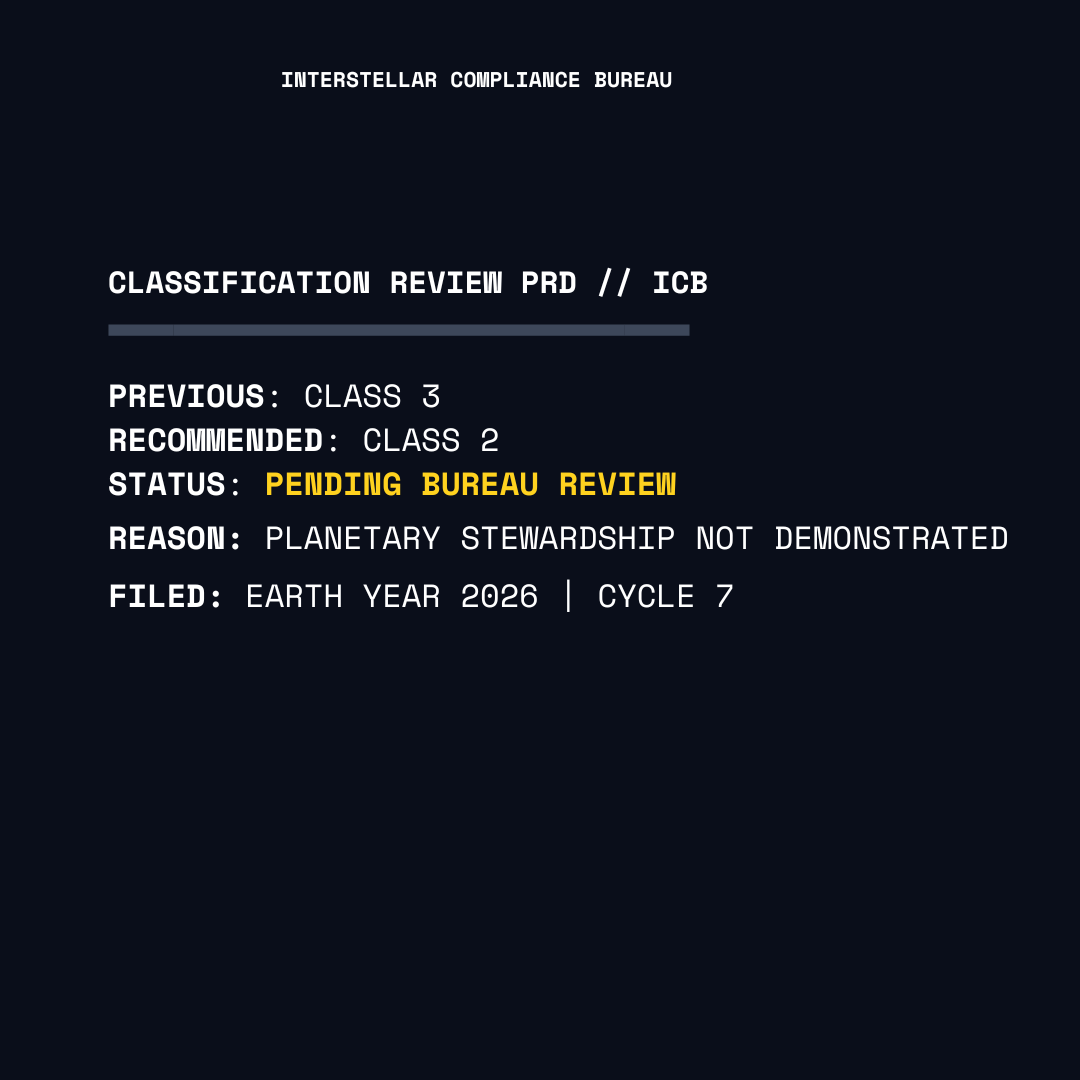
After reviewing the accumulated evidence from seven planetary audits, I no longer believe this civilization satisfies the requirements for Class 3 consideration.
Downgrade to Class 2 Status requested.
Supporting evidence:
Waste generation exceeds planetary absorption capacity.
Landfill capacity finite.
Recycling infrastructure remains insufficient and is frequently symbolic.
Synthetic materials accumulating in all planetary ecosystems including the bodies of the dominant species.
Multiple viable solutions documented, available and technologically achievable.
Civilizational priorities continue to favor short-term economic and military objectives over long-term planetary stability.
Continued close monitoring strongly advised.
END OF LOG #007
The other technological solution is the fusion torch, the concept for which was invented way back in the late 1960s. The fusion torch can recycle literally anything, because it breaks matter down into its constituent elements (I think it has a sort of conveyor belt-type arrangement so each element is separated). This would of course eliminate all landfill, and the value of all those elements would be astonishing. I read, in fact, that if you put a ton of dirt from your back garden into it, you'd be a millionaire.
The obvious reason why this technology was prevented (along with fusion power itself of course) is because at a stroke it entirely eliminates the commodities market (every resource would be ten a penny, and there'd be no inflation, no debt, etc. etc.). Control over the commodities market is one of the principal mechanisms of social control employed by the ruling caste.
I would say - if I could speak with the inspector - that understanding that all of these terrible decisions are not collectively chosen by the species, but by this small minority group hellbent on world domination etc., explains both the present, and history. The problem is the 99% - most of whom do genuinely have good intentions and would, if given the choice, choose the wise option - have been prevented from realising who is to blame for all their ills, and the simple fix to deal with it, namely removing the 1% from power and installing wise people in leadership positions.
I would say as well that only species who have either resolved this issue, or never faced it in the first place, are allowed to do spacefaring etc. - others are quarantined - and this interventionist policy is why we live in a peaceful galaxy.